
Should You Book a Sumo Wrestling Experience in Japan?
Sumo Wrestling is a sport you associate with nowhere else but Japan, and during my stay I knew I had to experience it. Besides the very basics, I came into the country knowing next to nothing about the sport. Which is why when in Japan, I could not wait to experience the Tokyo Sumo show.
In my experience I learnt about centuries-old traditions whilst watching retired professionals, and was even lucky enough to step into the ring myself, only to be quickly thrown out of it,
If you are heading to Tokyo, here is exactly why a sumo show should be on your itinerary, and what you need to know before you book.
Some links in this review are affiliate links, to learn more about how we use these, read our disclaimer.
- Quick Information
- Why I booked the Tokyo Sumo Show
- In a hurry? Book everything here:
- Changing our session
- Getting Settled at the Tokyo Sumo Show
- Tokyo Sumo Show: A Welcome and Introduction
- The History of Sumo in Japan
- The Rules of Sumo
- Meeting our Sumo Wrestlers
- The Spiritual Cleaning
- Sumo Training
- Sumo Moves Demonstration
- Sumo Battle
- Tokyo Sumo Show Q&A
- The Sumo Fight Ballot
- The Fight
- What Could Make the Tokyo Sumo Show Better?
- Tokyo Sumo Show Photo Opportunities
- Tokyo Sumo Show Frequently Asked Questions
Quick Information
Rating
4/5
Cost
From £46
Duration
1.5 – 2 Hours
Recommend activity?
Yes
Best for
Culture Lovers
Book ahead
1 – 2 days
Why I booked the Tokyo Sumo Show
A few months prior to my arrival, my friend Jessica was in Japan and went to an experience where you watch real sumo wrestlers fight, enjoy a few drinks, and if you are really lucky you get to fight one in a real match.
I thought it would be a really fun, and authentic way to experience the culture of Japan. I don’t often go to sporting events, as I like to take part. So I thought this would be the perfect combination of culture and physical activity.
Back to my own trip, and I was on my return to Tokyo. I had two full days left in Japan, and I could not wait to see my sumo fight.
In a hurry? Book everything here:
Activities:
Accommodation:
More from Japan:
Changing our session
I had made a last minute change on my flight to Tokyo. I was originally booked to be on an evening show that came with dinner. However a space had opened up on a Build Your Own Gameboy Workshop that would have clashed.
I had booked through Get Your Guide and I really appreciate how easy the process was to move times.
Now the showtime would be just after lunch, and that worked perfectly. We had been on the Shinkansen early that morning from Osaka, and after leaving our bags at the hotel we went for a bit of retail therapy before heading to our show.
Getting Settled at the Tokyo Sumo Show
There was no assigned seating, so as we got there early we managed to bag seats on the front row. There were some seats even closer, some sofas but they had no tables to rest drinks or snacks.
Each table had a QR code, so you could order beers, water and snacks without having to miss a second of the show. I ordered myself some chocolate and a beer to get started.
Tokyo Sumo Show: A Welcome and Introduction
The room began to fill after we took out seats, and soon the show would begin. We were introduced to our hosts, Paula and John, who were both brilliant. They came onto the stage, and were instantly fun and engaging.
We would start to learn a little about the history of sumo, before being introduced to the two wrestlers who would be battling today.

The History of Sumo in Japan
We started with an introduction to Sumo, which has been around in one form or another for between 1,500 to 2,000 years. Sumo as we know it in the modern day has developed in the last 200 years. But originally it was a ritual, done to ensure that there would be a bountiful harvest.
Being a Sumo Wrestler isn’t a job, it’s a lifestyle. With many committing from a young age to go to Sumo Schools. Every part of their lives becomes consumed by it, their diets, education, training, everything revolves around it.
The Rules of Sumo
Interestingly, Sumo has no weight class. You can get competitors between 85kg and up to 300kg. So how would you pair competitors? It all comes down to rank. The better you perform, the higher you rank, and the tougher the battles.
Sumo wrestlers use a combination of their weight and skill. Being heavy makes you harder to move, but being light keeps you nimble and you can use your opponents weight against them. The name of the game is to get your opponent out of the ring, and you can use your strength to pick them up and carry them, or your opponent’s weight against them and make them stumble out.
Meeting our Sumo Wrestlers
Today we had Mori and Ogawa. Two professionals who had been training from a young age. I think we had close to the perfect hosts, everyone was charismatic and funny. Mori and Ogawa had limited English, but were still able to communicate and provided a lot of laughs along the experience.
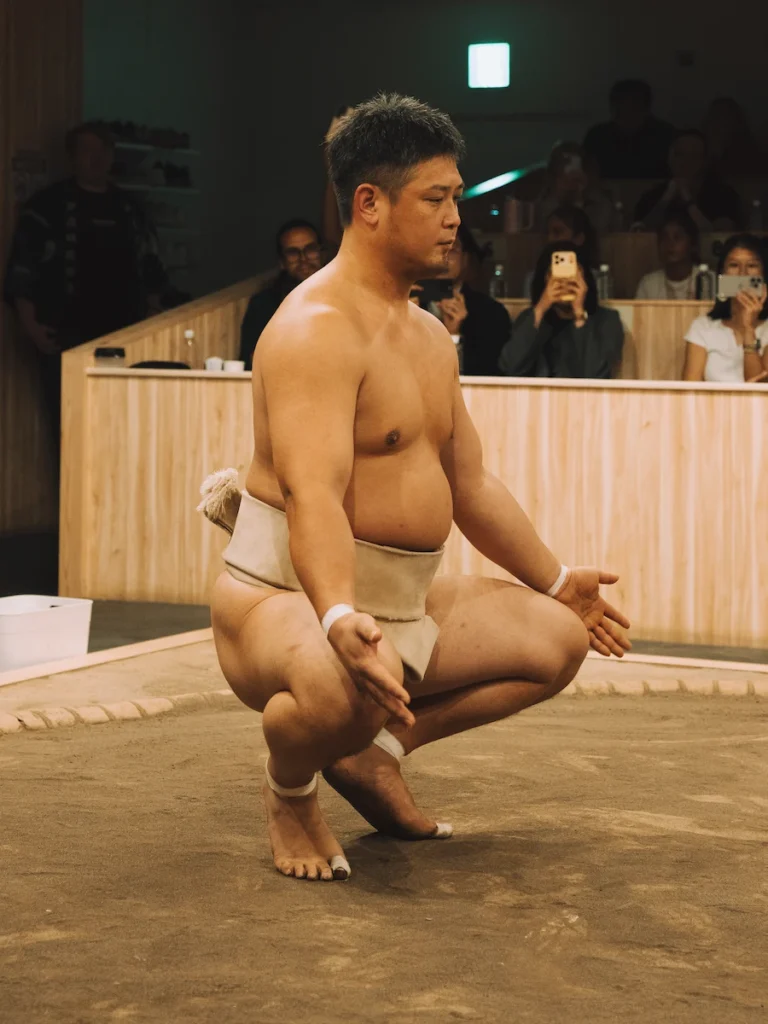
The Spiritual Cleaning
Before any fight can commence, there must be a spiritual cleansing. It involved five steps:
- Crouching down, a sign of humility
- Rubbing their hands together, to purify
- Clap their hands together, to get the attention of the Shinto Gods
- Hold their hands up, to show they are unarmed
- Lower their arms, to show that they are equals of the dojo.
Sumo Training
Mori and Ogawa would be demonstrating some of the training moves that all sumo wrestlers learn.
Shiko
After the cleansing, Mori and Ogawa would start to do a Shiko, an exercise used to strengthen their legs and the soles of their feet. They would raise a leg at the time, and stomp it into the ground. With every stomp, we were encouraged to shout “Yoi-Sho”. We were told there’s no literal translation, but it’s kinda like a “yee-haw”.
Teppo
This training technique involves striking a thick wooden pillar with the palms of their hands to strengthen the upper body. They did not have a wooden pillar to demonstrate. Instead they used each other’s bodies, which looked a lot more painful.
Suri-Ashi
Suri-ashi is a walking technique that allows sumo wrestlers to slide their feet along the floor. This lets them move quickly but maintain balance should they have to resist a strike.
Butsukari-geiko
For this technique you needed a partner, but one would repeatedly charge into a resisting partner. Allowing both sumos to practice offensive and defensive manoeuvres.
Sumo Moves Demonstration
We would now have a demonstration of how to win a Sumo match. We started with the two main techniques that would account for over 70% of title wins. They include Oshidashi (Push Out) and Yorikiri (Force Out), and are often called the bread and butter of sumo. We would also be learning about Hatikikomi (Slap down)
Oshidashi (Push Out)
Oshidashi is the act of pushing your opponent across the wrong path and eventually out of the circle.
Yorikiri (Force Out)
To win by Yorikiri, you have to grab and lift your opponent and carry them out of the ring. Often they are pushed to the edge and lifted over the circles edge.
Hatikikomi (Slap down)
This involves dodging to the side and slapping your opponent on the back when they pounce, causing them to fall onto the floor and lose the match.
Utchari (Miracle Throw)
Only used in tournaments a handful of times, this is when a sumo’s back is to the ring, and they grab and twist their opponent in a last ditch effort to throw them out of the ring.
Sumo Battle
It was now time to watch a real match at the Tokyo Sumo Show. We were assigned a fighter, and all chanted encouragement. My side had Mori, and they battled across three rounds. It was so much fun, and with the whole crowd really getting into it. All screaming for their champion to win.
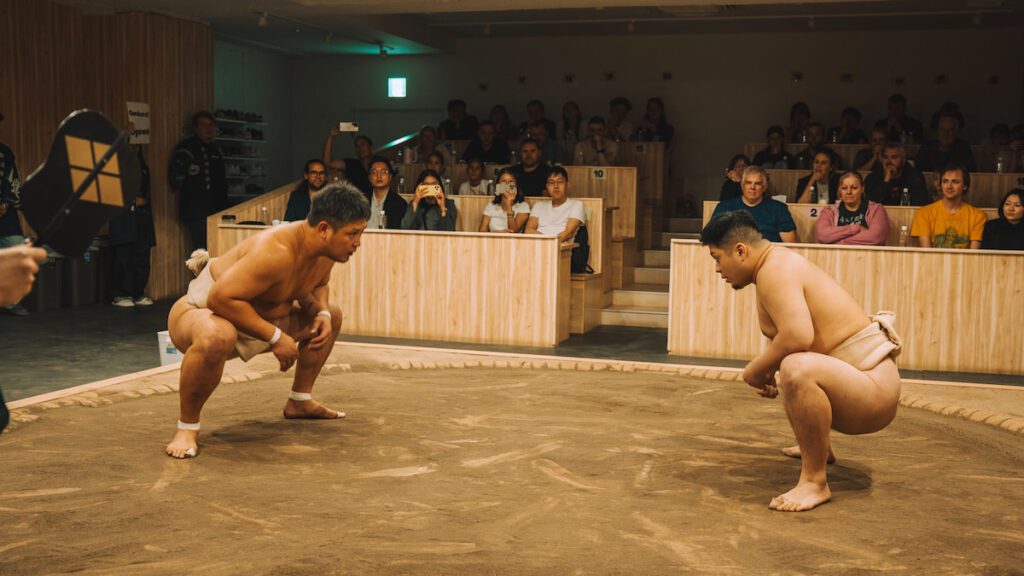
It got close, and when they were thrown out of the ring they really went. I am glad I had a table with us to act as a barrier, because I had no chance of being able to stop one as they careered towards me.
Apparently Sumo is coming to London this year so I will definitely have to watch another fight. How it compares to the Tokyo Sumo Show we will have to wait and see.
Tokyo Sumo Show Q&A
After their own fight, we were treated to a brief opportunity to ask any questions to the sumo’s. With John and Paula translating for us, it was really fun to ask anything we wanted to know. Including how they were able to live the lifetime and date, or have families. How many calories a day they eat, or even how they spend their free time.
We learned all about their diet, and Chanko nabe, a broth they eat that is filled with calories. A sumo consumers an average of 9,000 calories per day.
I thought this was a really nice touch. They could easily just do the talk, the show and we would have left satisfied. But having an opportunity to interact and ask questions was a welcome addition.
The Sumo Fight Ballot
The part that really caught my attention when booking, was that the activity advertised a chance to have a real fight with a sumo wrestler. And there was no way I could turn that down. What I didn’t know was that not everyone got the chance.
They asked for volunteers, and I put my hand up, and was escorted to another room. We were told there would only be time for 6 fighters. I quickly counted the room, there were eleven of us. We were told the children would automatically take part, so that left three chances.
Despite it being Japan, there was no fancy electronic way of selecting. Instead it was picking sticks, and whoever got one with a coloured tip was in. I picked my stick and prayed, it was green, I was in.
The Fight
I signed my health and safety papers, and they fitted me into an inflatable sumo suit. I liked to think it would have provided some reassuring comfort, but it did not. Instead I had to watch everyone else fight as I was scheduled to go last.
The women and children went first. We were told they would have a “play match”. They would push the sumo who would just stand and resist, before either picking them up and carrying them out, or more often with the children, pretending to be knocked out.
For men we were given two options, a play match, or a real one. Real rules, real effort, real consequences.
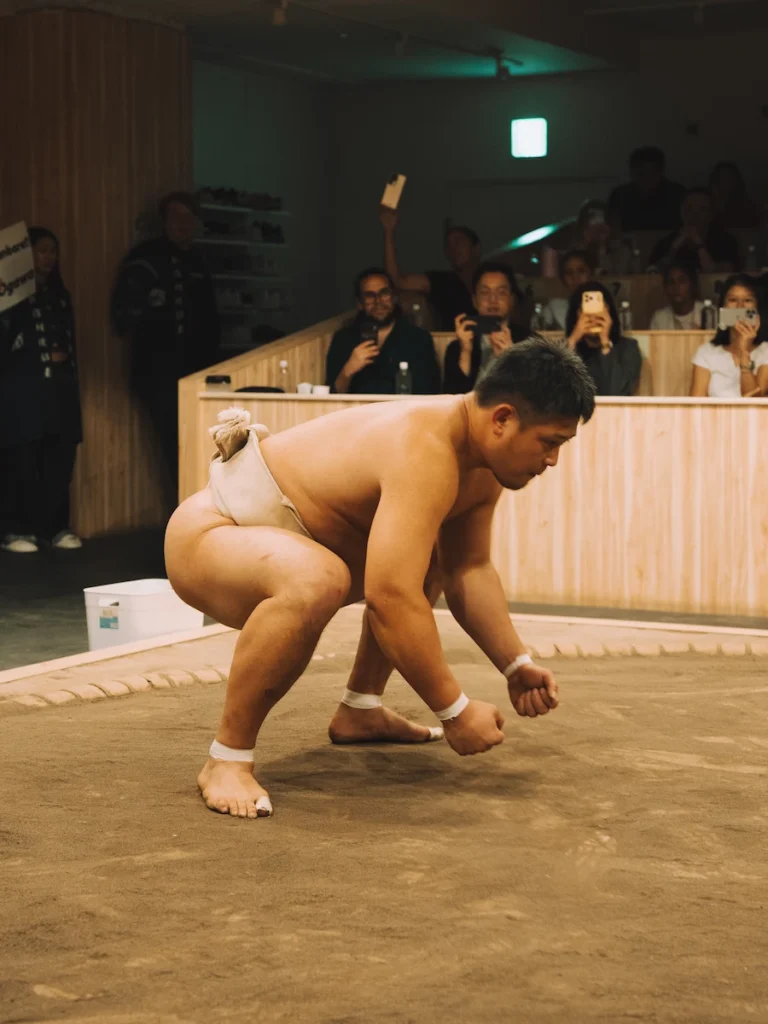
I was eventually called up. They ask you in front of everyone what game you want, and I couldn’t say a play one in front of the crowd. I would be up against Ogawa, who responded by asking if I was sure. “No” I feebly whimpered, but it was too late.
The match would start when both competitors’ knuckles touched the floor. Ogawa was first, I followed suit. Now this is a written blog, I could say that I put up an impressive bout, or I surprised even myself with my athletic prowess. But I am always honest about my experiences, and what actually happened was a freight train hit me and I was out in less than a second. Besides, a quick check on my social media would have unravelled my lie.
What Could Make the Tokyo Sumo Show Better?
I don’t think there could be much more done to improve the Tokyo Sumo Show. But I will highlight there are different options so you can choose what is best. Some of the evening shows have food included, but are a little more costly.
The show had ended the show on a high, but I couldn’t hang around for long. My next activity was building a Gameboy near Electric Avenue. Something I never thought I would have the opportunity do in my Japan trip.
Just keep in mind if you do order a show with food, you might want to be careful how much you eat if you intend to fight after.
Tokyo Sumo Show Photo Opportunities
After I pulled myself back onto my feet, it was time for the show to end. But we were each invited into the ring, either along or with friends and families, so that we could pose for a photo.
I liked this was included, so many places charge for photos now, so to be able to do it for free was nice. Everyone got involved, but we let the families go first as the kids were most excited.
The show had ended the show on a high, but I couldn’t hang around for long. My next activity was building a Gameboy near Electric Avenue. Something I never thought I would have the opportunity do in my Japan trip.